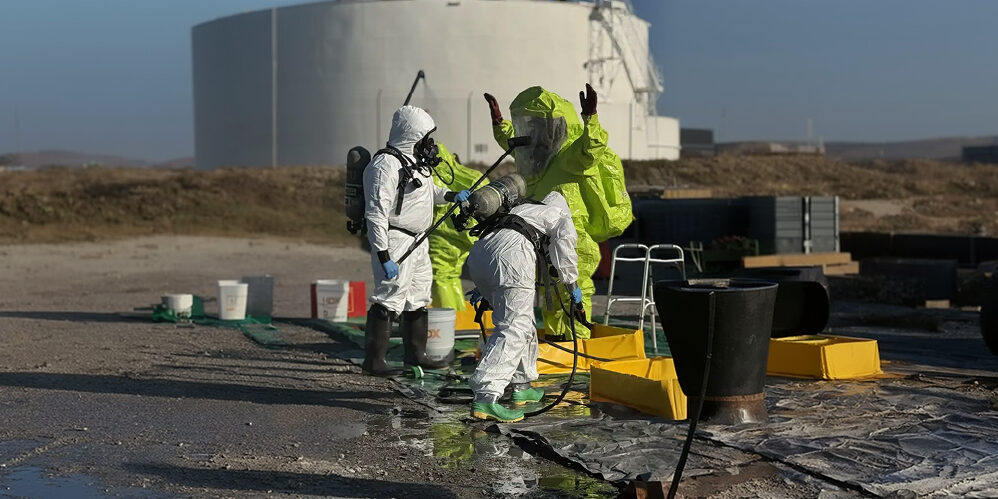
Open almost any cleanup proposal and you’ll see the phrase “HAZWOPER-trained crew.” It’s easy to read past, but it’s one of the most important lines in the document. It tells you whether the people who show up at your site have been trained to work safely around hazardous materials, and whether the contractor takes the rules seriously.
This guide explains what HAZWOPER is, who is required to have it, how the training levels work, and what to ask a contractor before you hire.
What HAZWOPER Means
HAZWOPER stands for Hazardous Waste Operations and Emergency Response. It’s an OSHA standard, found at 29 CFR 1910.120 for general industry and 29 CFR 1926.65 for construction. It sets health and safety requirements for people who work with hazardous substances. It applies to:
- Cleanup operations at uncontrolled hazardous waste sites
- Corrective actions at sites regulated under the Resource Conservation and Recovery Act (RCRA)
- Operations at hazardous waste treatment, storage, and disposal facilities
- Voluntary cleanups at sites recognized as uncontrolled hazardous waste sites
- Emergency response to releases, or potential releases, of hazardous substances
The Training Levels
The amount of training depends on the job. Here are the core requirements:
| Who | Initial training | Ongoing |
| General site workers (cleanup work with potential exposure) | 40 hours of off-site instruction plus at least 3 days of supervised field experience | 8-hour refresher every year |
| Occasional site workers (limited tasks, in areas characterized and not above exposure limits) | 24 hours of instruction plus at least 1 day of supervised field experience | 8-hour refresher every year |
| Supervisors and managers of cleanup operations | The same training as the workers they supervise, plus 8 hours of supervisory training | 8-hour refresher every year |
| Emergency responders | Set by role: awareness, operations (at least 8 hours), technician, specialist, and on-scene incident commander (at least 24 hours each) | Annual refresher or demonstrated competency |
What the 40-Hour Course Covers
- Recognizing chemical, physical, and biological hazards
- Selecting and using personal protective equipment, including respirators
- Air monitoring and site control
- Decontamination procedures
- Site health and safety plans and emergency procedures
- Medical surveillance and the basics of toxicology
- Hands-on practice with the equipment crews will actually use
Why It Matters in the Field
- Worker safety: The people at greatest risk on a cleanup site are the ones doing the work. Training is how they recognize a hazard before it hurts someone.
- Faster, steadier response: A trained crew knows how to size up a release, set up zones, and act without freezing or improvising. See what the first day of a response looks like in our emergency spill response guide.
- Compliance: OSHA enforces the standard. A contractor that skips it exposes you, as the site owner, to delays and questions you don’t need.
- Quality of work: Crews who understand the hazards sample, handle, and decontaminate correctly, which avoids cross-contamination and rework.
- Insurance and contracts: Insurers, lenders, and public agencies increasingly ask for proof of training.
HAZWOPER Isn't the Only Credential
HAZWOPER is the foundation, but many jobs need more:
- Respiratory protection: A written program, medical clearance, and fit testing before anyone wears a respirator.
- Confined space entry: Training, permits, and rescue planning for tanks, vaults, and pits.
- DOT hazmat training: Required for crews who prepare or ship hazardous materials (49 CFR 172.704).
- Job-specific training: Work such as battery incidents or PCB-containing equipment calls for training specific to that hazard.
- State credentials: Some work, like underground tank removal, requires a state-issued credential on top of HAZWOPER.
What to Ask a Contractor
- Are all field crew members’ current on the 40-hour course and the annual 8-hour refresher? Can you show me the certificates?
- Who supervises the job, and do they have the 8-hour supervisor training?
- Will you write a site-specific health and safety plan for this job?
- What air monitoring and decontamination procedures will you use?
- What other training does this job require, such as confined space, DOT hazmat, or respirator fit testing?
- Are your subcontractors held to the same standard?
Red Flags
- They can’t produce current certificates, or the refresher dates have lapsed.
- Training was entirely online, with no hands-on component.
- They rely on subcontractors you can’t identify.
- There’s no written safety plan.
- The answer to every question is “we’ve been doing this for years.”
What It Means for Owners and Municipalities
Asking for proof of training costs nothing, and it protects your site, your staff, and your reputation. Put the requirement in your bid documents and your contract, and ask for certificates before work begins.
ERC’s field crews are 40-hour HAZWOPER-trained and complete the annual 8-hour refresher. You can read more about our emergency response and hazmat teams, or see our past projects.
Frequently Asked Questions
Hazardous Waste Operations and Emergency Response. It’s the OSHA standard that sets training and safety requirements for people who clean up hazardous waste sites or respond to hazardous substance releases.
Yes, for covered work. OSHA requires it for workers at covered hazardous waste cleanup sites, treatment, storage, and disposal facilities, and for emergency response operations. States that run their own OSHA-approved programs have equivalent rules.
Workers need an 8-hour refresher every 12 months to stay current. Many employers and site owners treat a lapsed refresher as out of compliance until it’s completed, so ask for the most recent date.
The 40-hour course is for workers who regularly work on cleanup sites. The 24-hour course is for occasional site workers doing limited tasks in areas that are fully characterized and not above exposure limits.
Some content can be delivered online, but the training has to include hands-on practice with equipment such as protective gear and decontamination. A fully online course may not meet the requirement for field work, so ask the provider how the hands-on portion is covered.
