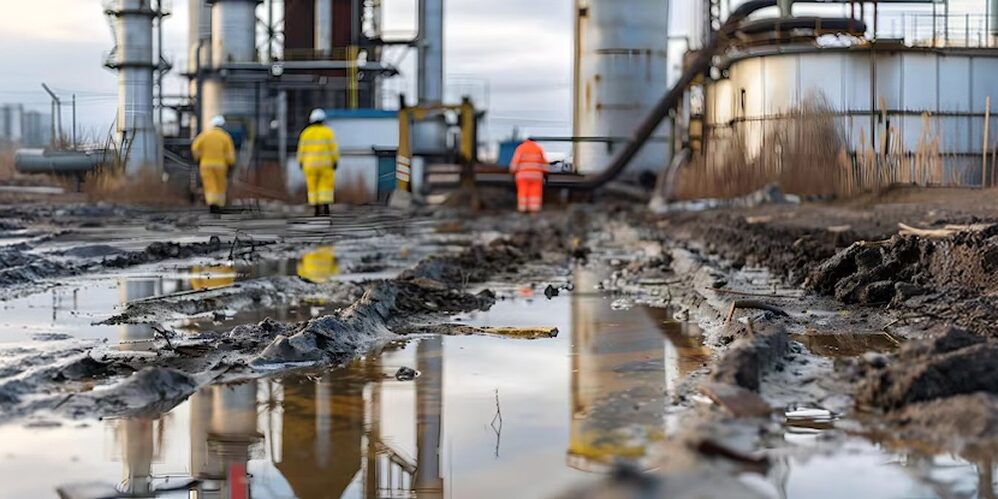
When a spill happens at a manufacturing plant, the response follows three steps: contain it, clean it up, and report it. Plant staff stop the source and contain the release with the spill kits and secondary containment already on site. A trained response contractor then recovers the material, decontaminates surfaces and manages the waste. Meanwhile, the facility makes any required notifications to federal, state and local agencies, often within minutes or hours. Environmental Remediation Contractor (ERC) supports plants nationwide with 24/7 industrial spill response. This guide walks through how well-run sites handle each step.
Common Spills at Manufacturing Facilities
- Hydraulic oil, lubricants and coolants from presses, CNC machines and conveyors
- Process chemicals such as acids, caustics, solvents and plating solutions
- Fuel and oil from aboveground tanks, generators and forklifts
- Wastewater or pretreatment system overflows
- Leaking drums and totes in storage and accumulation areas
- Releases during tanker unloading at the dock
Many of these releases stay inside the building. The serious ones are those that reach floor drains, storm sewers, soil or a nearby stream. Those trigger reporting, wider cleanup and, sometimes, long-term soil remediation or groundwater cleanup.
Step 1: Contain the Release
The first minutes belong to the plant’s own trained employees. A well-prepared site has a clear sequence:
- Make the area safe. Evacuate if needed, remove ignition sources and call 911 for fires, injuries or vapor exposure.
- Identify the material. Check labels and safety data sheets so responders know what they are dealing with.
- Stop the source if it is safe to do so: close valves, upright containers, shut down the pump.
- Protect the drains. Cover floor and storm drains with mats or plugs. This is the step that most often decides how big the incident becomes.
- Deploy absorbents and berms to keep the spill from spreading.
- Call your response contractor for anything beyond the size of an incidental spill.
Facilities that store more than 1,320 gallons of oil aboveground are usually required to have a Spill Prevention, Control and Countermeasure (SPCC) plan. That plan sets out secondary containment, inspections and response steps. Our guide to SPCC plan requirements explains who needs one.
Step 2: Clean Up and Decontaminate
Once the release is contained, the response contractor takes over the cleanup. At a plant, that usually involves:
- Product recovery. Vacuuming free liquid with vacuum trucks or pumping it into tanks or totes.
- Surface decontamination. Scrubbing and washing floors, containment areas and equipment, and collecting all rinse water.
- Drain and sewer cleaning. Jetting and vacuuming impacted floor drains, sumps, trenches and catch basins.
- Soil excavation. Removing impacted soil where the spill reached unpaved ground.
- Waste handling. Containerizing, sampling, profiling and shipping everything generated by the cleanup.
ERC self-performs this work with our own crews and equipment. That keeps one team accountable from first response to final disposal.
Step 3: Report the Incident
Reporting obligations depend on what spilled, how much and where it went. The main triggers for plants are:
| Requirement | When it applies | Who to notify |
| CERCLA reportable quantity | Hazardous substance released at or above its reportable quantity in 24 hours | National Response Center (800-424-8802), immediately |
| EPCRA Section 304 | Extremely hazardous or CERCLA substances above the reportable quantity | State emergency response commission and local emergency planning committee |
| Clean Water Act (oil) | Oil that causes a sheen on, or reaches, navigable waters | National Response Center |
| State spill rules | Varies by state. Ohio generally requires notice within 30 minutes of discovering a reportable release | State agency (Ohio EPA spill hotline: 800-282-9378), local fire department and LEPC |
| Permits (NPDES, pretreatment) | Releases that affect stormwater or wastewater discharges | Permit authority or local sewer utility |
Written follow-up reports are often due within days or weeks. In Ohio, for example, a written follow-up is generally due within 30 days. Keep a log from the start: time of discovery, material, estimated volume, actions taken, who was called and when. Your contractor’s daily notes, photos, manifests and disposal records support that report. If you are unsure whether a release is reportable, report it. Late reporting is a far bigger problem than a call that turns out to be unnecessary.
What to Have in Place Before a Spill
- An up-to-date SPCC plan and any state-required contingency plan
- Stocked spill kits sized for your largest likely release, placed near tanks, docks and process areas
- Drain covers and a map of where each drain goes
- Employees trained to their role, from incidental spill response to HAZWOPER for designated responders
- A pre-arranged emergency spill response agreement so your contractor can mobilize immediately
- A posted call list with your contractor’s 24/7 number, the state spill hotline and the National Response Center
How ERC Supports Manufacturing Sites
ERC works with plants and industrial operations through our manufacturing and industrial services. We cover emergency spill response, routine drum pickup and waste disposal, tank cleaning and the remediation work that follows a release. Every crew member holds 40-hour HAZWOPER training with an annual refresher. Our emergency response team is available 24 hours a day.
Want a response partner on file before your next incident? Set up an ERC emergency spill response agreement, or call 8776837724 any time for 24/7 industrial spill response.
Look for a contractor that understands both the environmental and construction sides of the work: HAZWOPER-trained crews, its own equipment, waste management experience and a record of working with state regulators. Many owners hire an industrial demolition company and an environmental contractor separately and then manage the handoff themselves. Using one environmental general contractor to run decommissioning, remediation and site restoration reduces that risk. Our contractor selection checklist lists the questions worth asking, and our manufacturing and industrial page shows the kinds of sites we work on.
If the property is headed for redevelopment, decommissioning is also the first step toward reuse. Ohio owners can read about the next stage in our guide to Ohio’s brownfield redevelopment process. Waiting tends to cost more, as our article on the true cost of delaying remediation explains.
Closing a plant, retiring equipment or preparing a site for sale? Talk to ERC about a decommissioning plan, or call (614) 769-6535.
Frequently Asked Questions
Make the area safe. Evacuate if needed, call 911 for fires, injuries or exposure, and remove ignition sources. Then identify the material, stop the source if it is safe to do so, and protect drains before calling your response contractor.
When the release meets a federal or state reporting trigger. Examples are a CERCLA reportable quantity, oil reaching waterways, or a state threshold such as Ohio’s 30-minute notice rule. Requirements depend on the material, the amount and where it went.
An incidental spill is small, the hazard is known, and trained employees can clean it up safely with the spill kits on hand. An emergency spill is larger, involves an unknown or highly hazardous material, or poses a fire, health or environmental threat. That calls for trained responders and often outside help.
No. SPCC plans cover oil, including fuel, hydraulic oil and lubricants. Chemical releases fall under other rules, such as CERCLA, EPCRA, RCRA and state requirements. Many plants keep a broader spill contingency plan that covers both.
The facility, as the responsible party, typically pays for cleanup, waste disposal and any follow-up remediation. Some property and pollution liability policies may cover part of the cost.
Yes. When a release reaches soil or groundwater, it may require investigation and remediation after the emergency phase ends. Fast containment and cleanup is the best way to avoid that.
