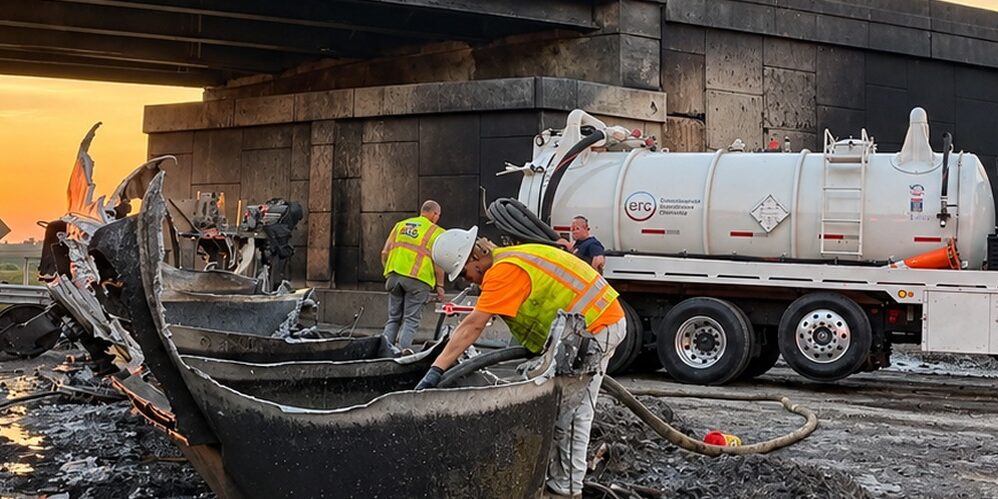
To choose emergency spill response services, look for a contractor with a live 24/7 dispatch line and crews based close to your sites. It should own its own vacuum trucks and containment equipment, and its crews should hold 40-hour HAZWOPER training. It should handle waste characterization and disposal in-house or through licensed partners, have clear rates and insurance, and be willing to set up a response agreement before you need it. The time to choose is before a spill, not during one. This checklist from Environmental Remediation Contractor (ERC) covers the questions to ask and the red flags to watch for.
If you are hiring for planned cleanup work, such as soil or groundwater remediation, see our separate remediation contractor checklist. Emergency response calls for a different set of criteria. As Indiana’s IDEM notes in its guidance on selecting a spill contractor, immediate mobilization is what sets spill work apart.
The Emergency Spill Response Checklist
1. True 24/7 Dispatch
Call the emergency number at 2 a.m. on a Sunday before you sign anything. Does a live person answer? Can that person mobilize a crew, or just take a message? A spill contractor’s value is only as good as its after-hours response.
2. Realistic Response Times for Your Locations
Ask where crews and equipment are based and how long it takes to reach each of your facilities or routes. Be wary of guaranteed arrival times that don’t account for distance, weather or traffic. A good contractor gives you an honest ETA on every call.
3. Self-Performed Equipment and Crews
Contractors who own their vacuum trucks, containment supplies, pumps, excavation equipment and roll-offs can respond without waiting on subcontractors. Ask what they own, what they rent and what they subcontract.
4. Capability for Your Materials and Settings
Fuel on a highway, acids at a plant, and oil in a creek are different jobs. Ask for examples of similar incidents, and look at past projects. Confirm the contractor can handle the settings you face: water, soil, roadways, confined spaces or energized utility sites.
5. Training and Safety Record
Every responder should hold 40-hour HAZWOPER training with current annual refreshers. Ask for the contractor’s safety program, its experience modification rate (EMR) and its incident history. A strong safety culture protects your people and your site, as well as theirs.
6. Waste Management From Scene to Disposal
Cleanup isn’t finished until the waste is properly disposed of, and you remain the generator. Ask how the contractor characterizes and profiles waste, which transporters and facilities it uses, and what documents you’ll receive. You should get manifests and disposal certificates. See what happens to hazardous waste after a spill for the full process.
7. Documentation and Communication
You’ll need records for regulators, insurers and your own files. Ask for a sample closeout report. Confirm you’ll get a named field supervisor, regular updates and itemized invoices.
8. Insurance, Licensing and Coverage Area
Request certificates for general liability, pollution liability, auto and workers’ compensation. Confirm the contractor operates in every state where you need coverage and holds any required state licenses, such as for tank work. ERC serves clients nationwide across the U.S.
9. Pre-Arranged Agreements and Clear Rates
Contractors without an existing agreement may require upfront payment before they mobilize. An emergency spill response agreement settles rates, contacts and billing in advance, so the response starts with one phone call.
Questions to Ask, at a Glance
| Question | A strong answer |
| Who answers your emergency line after hours? | A live dispatcher who can deploy crews |
| Where are your crews based? | Close to your sites, with honest drive times |
| What equipment do you own? | Vacuum trucks, containment, excavation and transport |
| What training do your crews hold? | 40-hour HAZWOPER plus annual refreshers for every crew member |
| How do you handle waste? | Profiling, licensed transport, approved facilities and full manifests |
| What will I receive at closeout? | Photos, timeline, volumes, manifests and an itemized invoice |
| Can we set up an agreement now? | Yes, with agreed rates and contacts on file |
Red Flags
- Emergency calls go to voicemail or an answering service with no dispatch authority
- Vague answers about where crews and equipment come from
- No pollution liability insurance
- Can’t explain how waste will be profiled or where it will go
- Pressure to skip sampling or paperwork to “save money”
- Unrealistic guarantees on response time or final cost before seeing the site
Industry-Specific Considerations
Utilities and energy companies need crews trained for substations, transformer oil releases and right-of-way work, as covered by our utilities and energy services. Oil and gas operators and pipeline companies need fast response to remote sites and experience with crude and produced water; see our oil and gas services. Fleets need corridor coverage, as explained in our guide to transportation emergency spill response. Plants need a partner who knows industrial settings; see manufacturing plant spill response.
Looking for a spill response partner you can count on? Set up an ERC emergency spill response agreement, call 614-769-6535 to talk to our team, or call 877.683.7724 for 24/7 emergency response.
Frequently Asked Questions
At minimum: 40-hour HAZWOPER-trained crews with current refreshers, a documented safety program, pollution liability insurance, the right equipment, licensed waste transport, and any state licenses required for the work.
Distance matters, because response time decides how far a spill spreads. But closeness alone isn’t enough. Weigh location alongside equipment, training, waste handling and 24/7 dispatch.
A spill contractor mobilizes immediately to contain and clean up a release. An environmental consultant typically investigates, samples and designs longer-term remediation. Some firms, including ERC, provide both emergency response and remediation.
Start with your state environmental agency. Indiana’s IDEM, for example, publishes guidance and a map of spill contractors serving the state, though the map is not all-inclusive. Then vet candidates with the checklist above.
Larger organizations with many sites often keep a primary and a backup contractor. At minimum, make sure your primary contractor covers every location and has the capacity for your largest likely spill.
Before you need it, ideally when you write or update your SPCC or spill contingency plan. An agreement on file means faster mobilization and no rate negotiations during an emergency.
