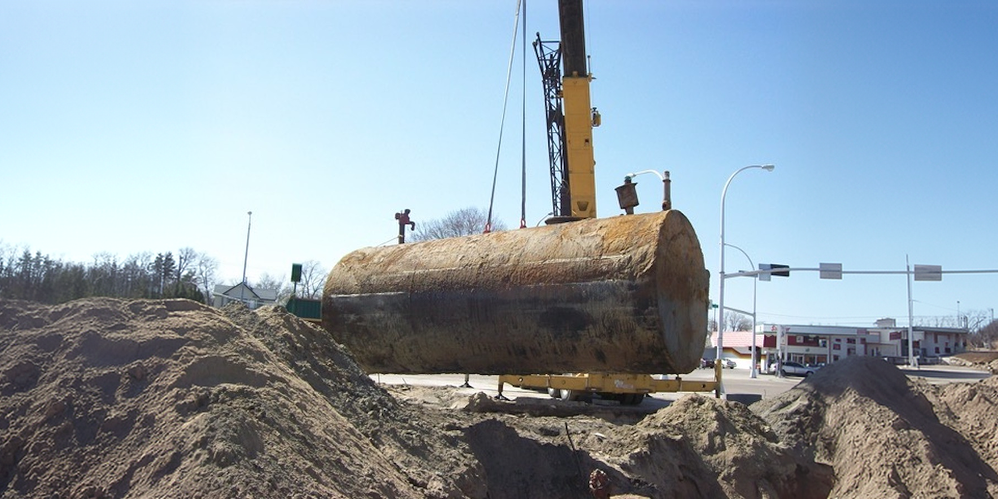
If you own a regulated underground storage tank (UST) and need it out of the ground, one of the first questions is who is legally allowed to do the work. The answer isn’t the same everywhere. There is no national UST remover license. Each state sets its own rules. In some states a permit is the main requirement. In others you need a certified contractor and a certified supervisor on site.
This guide covers the federal baseline, how states differ, and what the rules look like in the states ERC serves. For instance, see the Ohio process in particular, see our BUSTR closure guide. For what removal costs, see our UST removal cost guide. Supply as much information as you have about your storage tank for a Free Budget here.
The Federal Baseline: What Applies Everywhere
Federal UST regulations (40 CFR Part 280) require owners to notify the regulating agency before permanently closing a tank and to determine whether a release occurred. They don’t create a national remover license. Most states run their own UST programs with EPA approval, and states are allowed to be stricter than the federal rules. Many are.
How States Differ
Based on a review of state UST programs completed in September 2026, the picture breaks down like this:
- 31 states require a state-issued credential to physically remove a regulated petroleum UST. Depending on the state, it might be called a contractor license, a certification, a registration, or a supervisor or decommissioner certification.
- 19 states have no statewide removal credential: That doesn’t mean the work is unregulated. These states still require closure notices or permits, site assessment and sampling, and local approvals.
- A few states add a separate assessor: Iowa, New Jersey, Utah, and Wisconsin require a separately credentialed person for routine closure sampling, in addition to the remover.
- Some add credentials when contamination is found: Connecticut, Massachusetts, Nevada, New Jersey, Oklahoma, South Carolina, and others bring in a professional or corrective-action credential once a release is confirmed.
- Reciprocity is rare, and never automatic: Ohio and Arkansas have formal recognition paths for out-of-state credentials, but they are applications that require approval. Illinois and Nevada state that they do not recognize out-of-state licenses.
The Nine States ERC Serves
Here’s how the rules look in the states where ERC works. Treat this as a general summary, not a substitute for your regulator’s current requirements.
| State | Regulator | Credential for physical removal | Pre-closure step |
| Ohio | State Fire Marshal, BUSTR | Ohio-certified UST installer supervising removal | BUSTR permit |
| Illinois | Office of the State Fire Marshal | OSFM-licensed UST contractor plus ICC-certified decommissioning site supervisor | OSFM removal permit |
| Indiana | IDEM and State Fire Marshal | State-certified UST decommissioner | 30-day notice and inspection coordination |
| Kansas | KDHE | KDHE-licensed UST contractor | 30-day notice and closure authorization |
| Kentucky | Energy and Environment Cabinet and State Fire Marshal | Certified UST installer/remover or limited-function remover | Closure notice and approval |
| Michigan | LARA Bureau of Fire Services | No individual remover license identified | BFS removal permit |
| Missouri | DNR and Department of Agriculture | No removal credential identified | Closure notification and DNR oversight |
| Pennsylvania | DEP | DEP-certified storage tank remover | 30-day notification and local permits |
| Wisconsin | DATCP and DNR | Registered tank specialty firm plus certified remover/cleaner, and a certified site assessor | Advance notice and permit coordination |
Michigan and Missouri don’t have a statewide remover credential. Illinois, Indiana, Kansas, Kentucky, Ohio, Pennsylvania, and Wisconsin do. In all nine states, closure sampling or a site assessment is part of the process, and permits or notices come first.
Rules and forms change: This table reflects a September 2026 review. Confirm current requirements with your state agency before you hire or schedule work. EPA keeps a directory of state UST program contacts.
Why the Credential Matters to Owners
- Permits and approvals: Many states won’t issue a removal permit, or accept a closure report, unless the work was done by an authorized contractor.
- Closure and cost recovery: Work by an unqualified contractor can jeopardize closure approval and any state cost-recovery eligibility you might have.
- Safety: A tank that looks empty can still hold vapors and sludge. Credentialed crews are trained for exactly that.
- Defensible records: A closure performed by a credentialed firm produces documentation that regulators, lenders, and buyers will accept.
Beyond the State: Local Rules
A clean answer at the state level isn’t the whole picture. Local fire marshals, building departments, and excavation or right-of-way rules can add permits and inspections. Air, waste transport, and disposal requirements can add more. Every project needs a local check before work begins.
How to Check a Contractor's Credentials
- Ask for the credential name and number, and verify it with the state agency, not just the certificate.
- Ask who supervises the removal on site, and whether that person holds the state credential.
- Ask who collects the closure samples, which lab runs them, and who signs the closure report.
- Ask how they handle permits and inspection scheduling.
- Ask how tank contents and any contaminated soil will be disposed of, and who handles the paperwork.
- If a release is found, ask who takes over and how quickly.
What about Heating Oil, Farm, and Aboveground Tanks?
This guide covers federally and state-regulated petroleum underground tanks being permanently removed. Residential heating-oil tanks, farm tanks, aboveground tanks, and tanks holding hazardous substances can follow different rules. Check with your state agency about your specific tank.
Working across State Lines
Owners with tanks in several states, such as fleets, retailers, municipalities, and manufacturers, run into this most. Because credentials rarely carry from one state to the next, the contractor you used in one state may not be authorized to remove tanks in another.
ERC serves nine states and plans each tank project around that state’s own credential and permit rules, working with state-certified personnel where the state requires it. Learn more about our underground and aboveground storage tank services.
Frequently Asked Questions
No. Federal UST rules set notification and closure requirements, but credentials are set by each state, and some states have none at all. Local requirements can apply on top.
Ohio’s Bureau of Underground Storage Tank Regulations (BUSTR) requires a permit, and the removal is supervised by an Ohio-certified UST installer. Confirm current requirements with BUSTR before scheduling.
Usually not on that license alone. Most states have no automatic reciprocity. A few, including Ohio and Arkansas, have application paths for out-of-state credentials, but approval is needed first.
In all nine states ERC serves, closure sampling or a site assessment is part of permanent closure. Who can collect the samples varies, and some states require a separately certified assessor.
The release has to be reported and addressed under state rules. Some states bring in additional credentials, such as a certified consultant or licensed professional, at that point. A contractor with remediation capability can move from removal to cleanup without a gap.
