

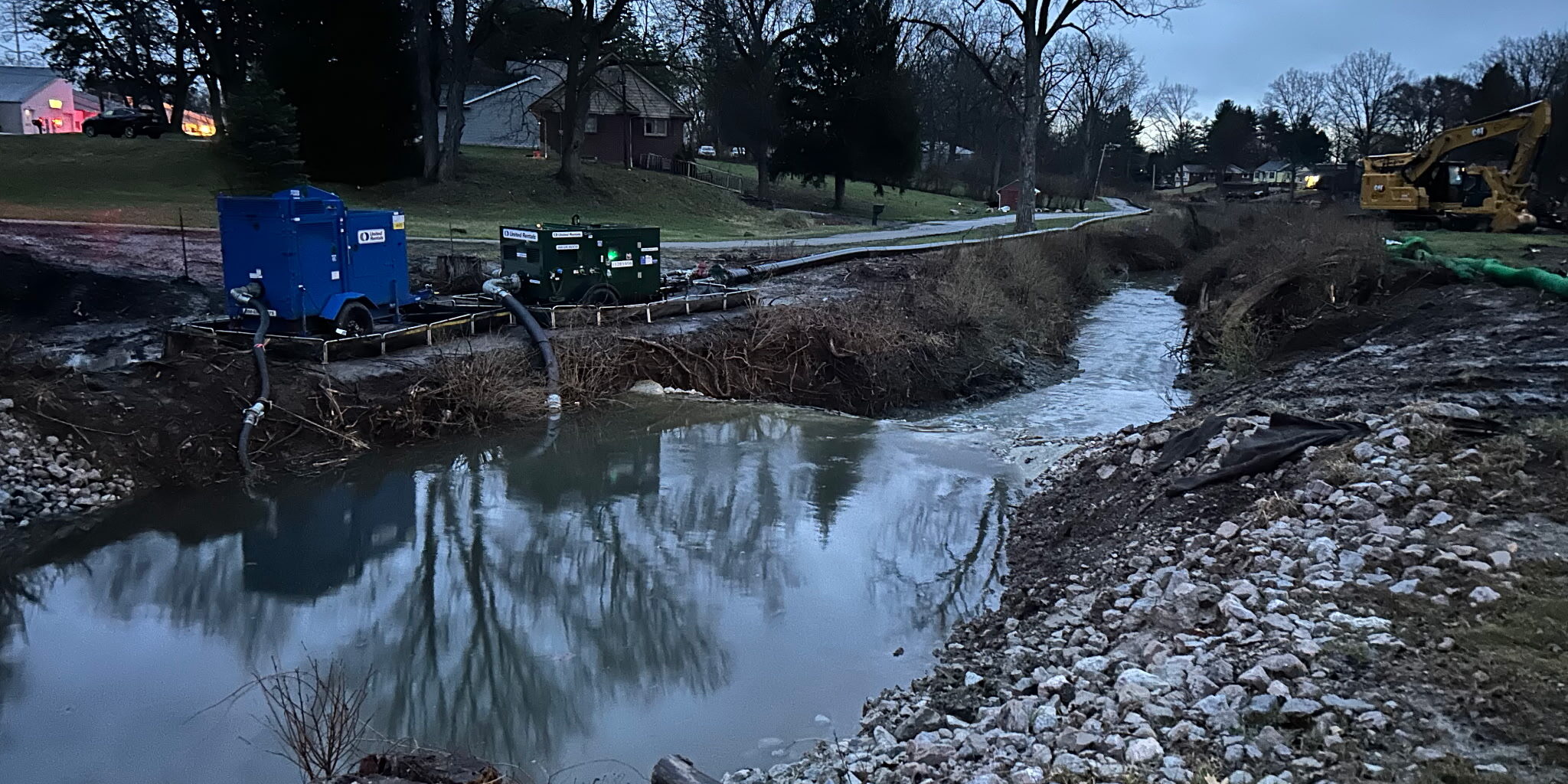
Look at a stream that’s in trouble and the signs are usually obvious: banks cut straight down six or eight feet, tree roots dangling in the air, brown water after every storm, and a channel that looks more like a ditch than a creek.
Stream restoration fixes the underlying shape of the stream, not just the symptoms. When it’s done well, the payoff shows up in cleaner water, steadier banks, and less damage when high flows arrive. Here’s how it works, what it can and can’t do, and what it looks like in practice.
Why Streams Break Down in the First Place
Most degraded streams share a few causes. Urban and suburban development sends more runoff, faster, into the channel. Straightening and culverts remove the natural curves that slow water down. Clearing streamside vegetation removes the roots that hold banks together.
The result is channel incision. Water speeds up, cuts down into the bed, and undercuts the banks. Banks collapse, sediment pours downstream, and the stream can no longer spread out onto a floodplain when it rises. Each storm makes it worse.
How Restoration Improves Water Quality
- Less sediment: Eroding banks are a major sediment source. Stabilizing them with rock, logs, and deep-rooted plants keeps soil out of the water, which protects aquatic life and downstream lakes and reservoirs.
- Less nutrient and pollutant load: Sediment carries phosphorus with it, and reconnected floodplains and riparian buffers help filter and absorb nutrients before they move downstream.
- Better habitat and oxygen: Riffles aerate the water. Pools provide refuge for fish. Shaded, vegetated banks keep water cooler. Together those changes support healthier fish and macroinvertebrate communities.
How Restoration Reduces Flood Damage
It’s worth being precise here. Stream restoration won’t stop a major flood. What it can do is change how a stream handles high flows, and that matters:
- It gives water room to spread: Reconnecting a stream to its floodplain lets rising water spread out and slow down instead of racing down a narrow channel.
- It reduces the destructive energy of high flows: A channel with proper dimensions, bends, and grade control moves water more calmly and erodes less.
- It protects what’s next to the stream: Stable banks keep land, trails, utilities, and foundations from being undermined.
The honest framing is reduced flood damage and erosion, not flood prevention. Where the main concern is flooding of structures, restoration is typically one part of a broader stormwater strategy.
What the Work Involves
Modern restoration typically follows natural channel design principles. Common techniques include:
- Reshaping the channel so its width, depth, and curves match what the stream can carry without eroding
- Building a floodplain bench so higher flows can spread out
- Riffles, pools, and grade control to dissipate energy and create habitat
- In-stream structures such as cross vanes, J-hooks, log steps, and root wads that direct flow away from banks
- Bank stabilization using rock, matting, compost filter sock, and live plantings
- Native riparian planting to shade the stream and hold soil long term
Construction crews also have to manage water during the work, protecting the stream and the surrounding area as they dig. Permits are generally required for work in streams, typically including Clean Water Act Section 404 authorization and state certification. Our stream and river restoration services cover design-build and construction-only roles.
Signs a Stream Needs Restoration
- Vertical, bare banks, often several feet high
- Exposed roots, fallen trees, and chunks of bank slumping into the water
- A channel that looks like a ditch: straight, uniform, and deep
- Muddy water long after storms have passed
- Little habitat variety: no riffles, no pools, little shade
- Infrastructure at risk: a bridge abutment, culvert, pipe crossing, or trail being undermined
Common Mistakes in Stream Projects
- Relying only on hard armor: Rock or concrete on one bank can push energy to the next bank or the next property downstream.
- Ignoring the floodplain: A well-shaped channel with nowhere to spill high flows will keep eroding.
- Designing for average flows: Streams do their work in storms, so designs have to hold up to them.
- Planting without a plan to establish it: A bare new bank is vulnerable until roots take hold, so temporary protection and follow-up matter.
- Treating it as a one-time fix: Restored streams adjust, and a monitoring period catches small problems early.
Projects That Show How It Works
- Mill Creek, Evendale, Ohio (2018): As general contractor for the Village of Evendale, with Sustainable Streams as design engineer, ERC built a riffle, rock toe, buried grade control, and full-site grading and restoration. See the project.
- Arcola Creek Headwaters, Madison, Ohio (2017): For the Village of Madison, with CT Consultants as design engineer, ERC regraded and sloped the creek and installed rock structures, log structures, and root wads. See the project.
- McCammon Creek, Delaware County, Ohio (2020): ERC and Burgess & Niple built two new stream reaches with log steps, cascades, J-hooks, riffles, and cross vanes, plus a new floodplain. Reusing substrate from the abandoned channels stretched the project budget. See the project.
- Country club stream, Akron, Ohio: ERC rebuilt a damaged channel with rock, J-hooks, and compost filter sock bank stabilization at a country club, using matting to protect the surrounding area from equipment. See the project.
- Golf course sinkhole, Lexington, Kentucky: ERC repaired a sinkhole and restored 2,200 linear feet of stream with boulder placement, turf, and native plantings. See the project.
What Success Looks Like After Construction
A restored stream doesn’t look finished on day one. Banks are raw, plantings are small, and the channel hasn’t yet been tested by a big storm. Reasonable expectations for the first few years:
- Year one: vegetation is establishing, temporary protection is doing the work, and the structures are proving themselves in the first high flows.
- Years two and three: roots are taking over from matting and stakes, banks are holding, and riffle and pool patterns are visible.
- Beyond: a stable, self-maintaining channel with shade, habitat, and a floodplain that does its job.
Small adjustments are normal. A monitoring period exists so those adjustments get caught and corrected early, rather than discovered after a failure.
What Drives Cost and Timeline
Stream restoration costs vary widely because every stream is different. The biggest drivers are the length of channel, how much earth has to be moved, site access, the amount of rock and structure required, permitting complexity, and planting scope. A short bank stabilization job is a very different project from a multi-thousand-foot channel rebuild. A site visit and design review are the only reliable way to get a real number.
Frequently Asked Questions
Not entirely. Restoration can reduce flood damage by reconnecting the stream to its floodplain, slowing high flows, and stabilizing banks. It won’t stop a major flood on its own, and it’s usually one part of a broader stormwater approach.
It reduces sediment from eroding banks, helps filter nutrients through floodplains and vegetated buffers, and improves habitat and oxygen levels through riffles, pools, and shade.
Construction can range from weeks to a few months depending on length and complexity. Design, permitting, and funding often take longer than the field work, and vegetation monitoring continues for years.
Almost always. Work in streams typically involves federal Clean Water Act Section 404 authorization and state water quality certification, along with state or local approvals. Requirements vary by state.
Bank stabilization protects a specific eroding bank. Stream restoration rebuilds the broader channel, floodplain, and habitat so the stream functions properly. Some projects are one, some are the other, and many combine both.
